

CALCULUS VISION
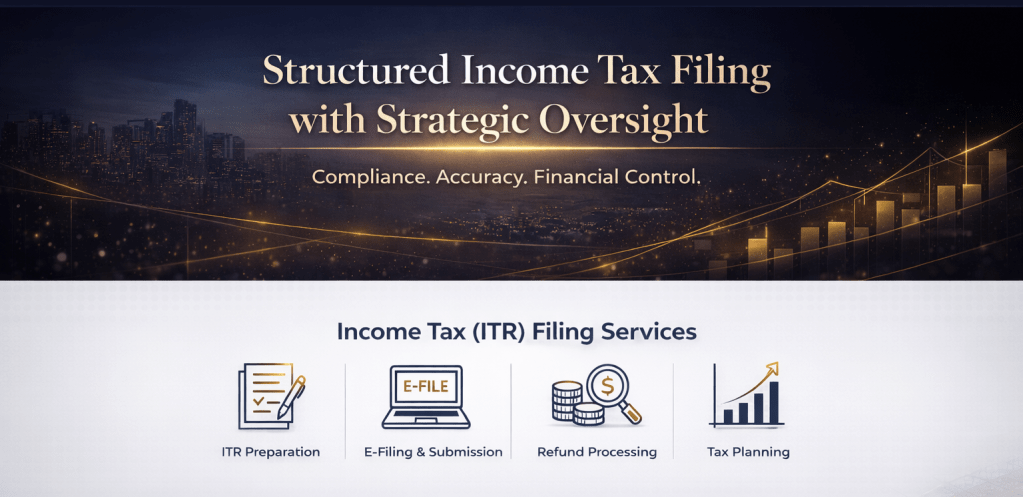
Accurate reporting. Optimised tax position. Zero compliance stress.
Income Tax Return (ITR) filing is not merely a statutory requirement—it is a financial disclosure that defines your tax profile, regulatory standing, and financial credibility. Whether you are an individual, professional, business owner, or corporate entity, proper ITR filing ensures compliance with the Income Tax Department and protects you from notices, penalties, and future litigation.
At Calculus, ITR filing is handled with analytical precision, ensuring that income classification, deductions, exemptions, and disclosures are aligned with the provisions of the Income-tax Act, 1961 and applicable rules.
Scope of Income Tax Return (ITR) Filing
Correct computation today prevents scrutiny tomorrow.
- Computation of Total Income
Income from salary, house property, business or profession, capital gains, and other sources is carefully analysed and classified. Proper computation ensures accurate tax liability without underreporting or overpayment. - Tax Planning and Deduction Optimisation
Eligible deductions under Chapter VI-A, exemptions, set-off and carry-forward of losses are evaluated systematically. The objective is to ensure lawful tax optimisation within the framework of the Act. - Selection of Appropriate ITR Form
Filing under the correct ITR form (based on income type, residential status, and entity classification) is critical. Incorrect form selection can render the return defective. - Compliance with Disclosure Requirements
Reporting of foreign assets, high-value transactions, capital gains schedules, and audit-related disclosures is handled with precision to avoid mismatch notices.
Individuals & Salaried Taxpayers
Beyond Form 16 — comprehensive tax evaluation.
- Detailed review of salary structure, perquisites, exemptions, and deductions.
- Reporting of additional income such as interest, rental income, or capital gains.
- Verification of TDS credits with Form 26AS and Annual Information Statement (AIS).
- Advisory on old vs new tax regime evaluation for optimal tax outcome.
Business & Professional ITR
Financial accuracy meets statutory compliance.
- Preparation of profit and loss accounts and balance sheet where required.
- Presumptive taxation evaluation under relevant sections, if applicable.
- Compliance with tax audit requirements under Section 44AB, where triggered.
- Reporting of depreciation, business losses, and partner remuneration correctly.
Capital Gains & Investment Reporting
Structured disclosure of asset transactions.
- Computation of short-term and long-term capital gains.
- Indexation benefits and exemption planning under applicable sections.
- Reporting of equity, mutual funds, property, and other asset transfers.
- Alignment of broker statements and transaction summaries with tax computation.
Notice Handling & Revised Returns
Proactive response to regulatory communication.
- Rectification of defective returns under Section 139(9), if issued.
- Filing of revised returns in case of errors or omissions.
- Assistance in responding to income tax notices and mismatch queries.
- Representation support in assessment proceedings, where required.
Why Structured ITR Filing Matters
- Prevents penalty under-reporting or late filing consequences.
- Ensures accurate carry-forward of losses for future tax benefit.
- Builds financial credibility for loans, visas, and funding requirements.
- Minimises risk of scrutiny or reassessment proceedings.
Income Tax Return filing at Calculus is not treated as a routine submission—it is a compliance exercise backed by analytical review, documentation discipline, and forward-looking tax planning.

 CALCULUS VISION