

CALCULUS VISION
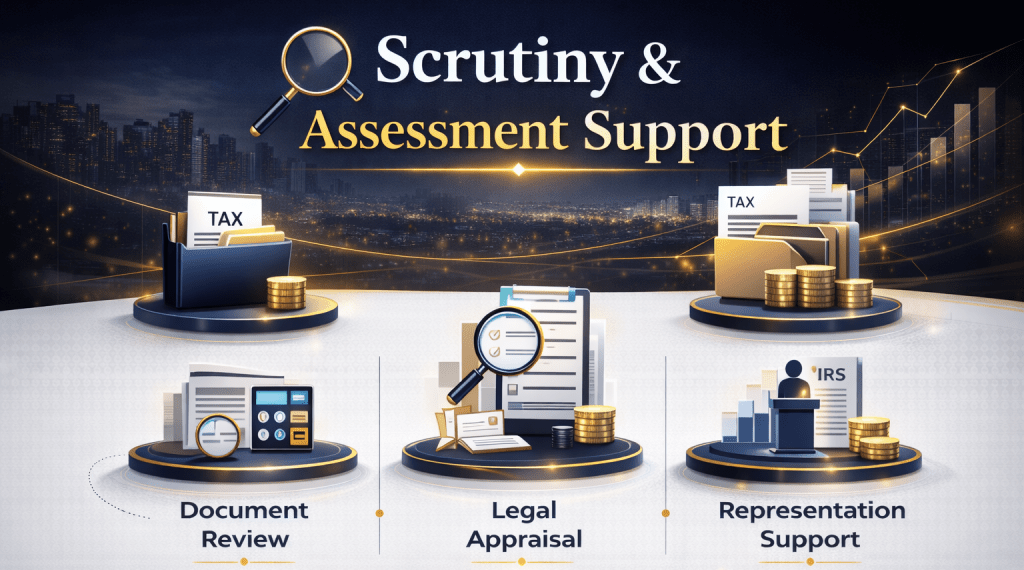
Scrutiny Assessment Support
When scrutiny begins, preparation and precision matter most.
A scrutiny assessment is initiated when the Income Tax Department selects a return for detailed examination to verify correctness of income, deductions, exemptions, and disclosures. This process involves structured notices, document submissions, and clarifications under the provisions of the Income-tax Act, 1961.
Scrutiny does not automatically imply wrongdoing—but improper handling can escalate routine verification into prolonged litigation. At Calculus, scrutiny support is handled with technical analysis, documentation discipline, and strategic representation.
Understanding Scrutiny Assessment
Verification of facts, backed by statutory authority.
- Selection of Return for Scrutiny
Returns may be selected based on risk parameters, high-value transactions, mismatch in reporting, or random selection under prescribed procedures. - Issuance of Notice
Notices are typically issued under relevant sections (such as Section 143(2) or 142(1)), requiring submission of books of accounts, explanations, or supporting documents. - Assessment Proceedings
The Assessing Officer reviews submissions, seeks clarifications, and determines whether the declared income is accurate or requires adjustment.
Proper response at each stage determines the outcome of the assessment.
Scope of Scrutiny Support
Structured handling. No reactive compliance.
- Notice Analysis and Risk Evaluation
Detailed review of the notice to understand scope, timelines, and specific areas of concern raised by the department. - Documentation Review and Preparation
Compilation of books of accounts, bank statements, agreements, invoices, capital gain workings, and other documentary evidence to substantiate claims. - Drafting Technical Submissions
Preparation of legally sound, clause-based written responses supported by judicial precedents where required. - Representation before Authorities
Coordinated communication and virtual/physical representation during hearings to ensure clarity and consistency in explanations.
Key Areas Commonly Examined
Focus on income accuracy and disclosure integrity.
- Capital gains computation and exemption claims.
- Business expenses and disallowances.
- Cash deposits and high-value transactions reflected in AIS.
- Related-party transactions and unsecured loans.
- TDS compliance and reconciliation mismatches.
- Set-off and carry-forward of losses.
Each of these areas requires structured documentation and technical defence.
Post-Assessment Support
Closure with clarity.
- Review of assessment order for computational or legal errors.
- Filing of rectification applications, if required.
- Advisory on appeal proceedings before appellate authorities, where necessary.
- Strategic planning to prevent recurrence of similar scrutiny triggers.
Why Professional Scrutiny Support Matters
- Prevents avoidable additions due to inadequate response.
- Reduces risk of penalty initiation under related provisions.
- Ensures consistency between financial records and tax submissions.
- Protects taxpayer credibility and long-term compliance profile.
Scrutiny assessment is a technical process that demands structured documentation, legal interpretation, and disciplined representation. With Calculus, scrutiny support is handled proactively—protecting your tax position with precision and regulatory confidence.

 CALCULUS VISION