

CALCULUS VISION
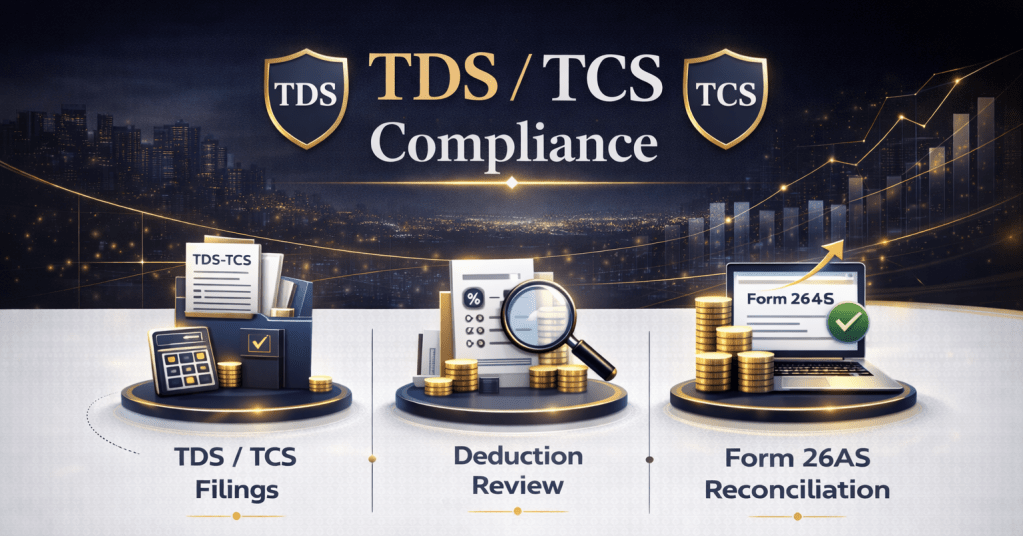
TDS & TCS Compliance
Deduct correctly. Deposit on time. Report accurately.
Tax Deducted at Source (TDS) and Tax Collected at Source (TCS) are statutory compliance mechanisms under the Income-tax Act, 1961, designed to ensure systematic tax collection by the Income Tax Department. For businesses, these are not optional processes—they are mandatory obligations with strict timelines and reporting standards.
At Calculus, TDS & TCS compliance is managed as a structured control function, ensuring correct deduction/collection, timely deposit, accurate return filing, and reconciliation to prevent penalties and disallowances.
Understanding TDS Compliance
Incorrect deduction today can trigger disallowance tomorrow.
- Identification of Applicable Transactions
Payments such as salary, professional fees, contractor payments, rent, commission, interest, and purchase transactions (where applicable) must be analysed to determine TDS applicability under relevant sections. - Correct Rate Determination
Deduction rates vary based on nature of payment, threshold limits, PAN availability, and special provisions. Incorrect rate application may result in short deduction and consequential interest liability. - Timely Deposit of TDS
Deducted tax must be deposited within prescribed timelines. Delays attract interest under Section 201(1A) and may also lead to penalty exposure. - Quarterly TDS Return Filing
Accurate filing of quarterly returns ensures proper credit reflection in the deductee’s Form 26AS/AIS and prevents mismatch notices.
Understanding TCS Compliance
Collection responsibility carries equal compliance weight.
- Applicability Review
TCS applies to specified transactions such as sale of certain goods, overseas remittances, scrap sales, and other notified categories. Proper evaluation of turnover thresholds and transaction type is critical. - Collection and Deposit Management
Collected tax must be deposited within statutory due dates to avoid interest and penalty implications. - Quarterly TCS Return Filing
Returns must reflect accurate buyer details, collection amounts, and challan references to ensure credit availability to the counterparty.
Scope of TDS/TCS Compliance Services
From transaction analysis to return reconciliation.
- Detailed transaction-level applicability review.
- Rate validation and deduction/collection computation.
- Challan generation and timely deposit monitoring.
- Preparation and filing of quarterly TDS/TCS returns.
- Issuance of TDS certificates (Form 16 / 16A).
- Reconciliation with books of accounts and Form 26AS.
- Rectification of defaults reflected in TRACES portal.
Risk Areas Commonly Observed
Minor lapses can lead to major financial exposure.
- Short deduction or non-deduction of tax.
- Late deposit of TDS/TCS amounts.
- Incorrect PAN reporting leading to higher rate deduction.
- Mismatch between books and filed returns.
- Disallowance of expenses under Section 40(a)(ia) due to non-compliance.
Proactive compliance prevents cascading financial and regulatory consequences.
Importance of Structured TDS/TCS Management
- Avoids interest and penalty exposure.
- Prevents disallowance of expenses during assessment.
- Maintains vendor and employee confidence through accurate credit reporting.
- Reduces risk of notices and scrutiny from tax authorities.
TDS and TCS compliance is a high-frequency, high-risk compliance area that demands continuous monitoring. At Calculus, it is managed with systematic controls, precise reporting, and statutory discipline—ensuring seamless compliance and financial stability.

 CALCULUS VISION