
CALCULUS VISION
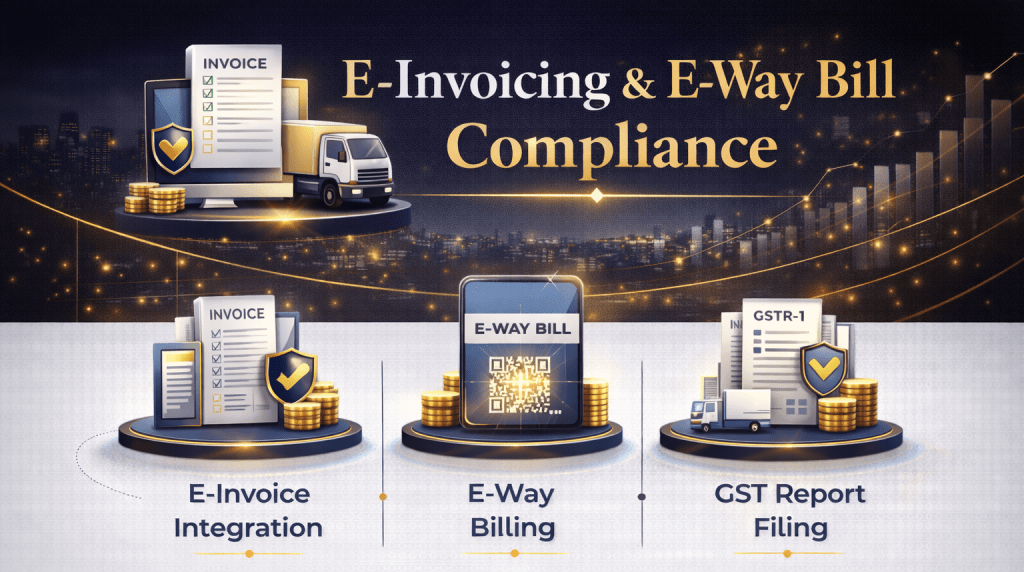
E-Invoicing & E-Way Bill Compliance
Real-time reporting. Seamless movement. Zero disruption.
E-Invoicing and E-Way Bill systems are technology-driven compliance mechanisms introduced under the Central Goods and Services Tax Act, 2017 to ensure transparency, prevent tax evasion, and enable automated reconciliation within the GST ecosystem managed through the Goods and Services Tax Network.
For eligible taxpayers, compliance is mandatory and system-integrated. Errors in generation, reporting, or reconciliation can block input tax credit, delay goods movement, and trigger departmental notices.
At Calculus, E-Invoicing and E-Way Bill compliance is handled through structured process alignment, ERP validation, and reconciliation control.
E-Invoicing Compliance
Invoice validation before supply movement.
- Applicability Assessment
Determination of turnover thresholds and transaction categories requiring e-invoice generation in compliance with notified rules. - IRN & QR Code Generation
Ensuring invoices are reported to the Invoice Registration Portal (IRP) for generation of Invoice Reference Number (IRN) and digitally signed QR code before issuance. - Data Accuracy & Schema Validation
Verification of invoice data fields, HSN/SAC codes, tax rates, and buyer details to prevent rejection or mismatch in GST returns. - System Integration & ERP Alignment
Advisory on integration of accounting/ERP systems with IRP to enable seamless automated compliance. - Amendment & Cancellation Handling
Managing timelines and procedural requirements for invoice cancellation or correction within permissible limits.
E-Way Bill Compliance
Movement without disruption.
- Generation of E-Way Bills
Creation of e-way bills for movement of goods exceeding prescribed value thresholds, ensuring correct vehicle and transporter details. - Validity Monitoring
Tracking e-way bill validity period to avoid detention or penalties during transit. - Part-A and Part-B Accuracy
Ensuring accurate reporting of supply value, HSN codes, and vehicle details to prevent inspection-based disputes. - Multi-Modal & Branch Transfers
Advisory on generation in case of job work, stock transfers, or multi-vehicle consignments.
Reconciliation & Risk Control
Mismatch today can lead to notice tomorrow.
- Reconciliation of e-invoices with GSTR-1 and GSTR-3B.
- Matching e-way bill data with sales registers and logistics records.
- Identifying duplicate, rejected, or cancelled IRNs.
- Validation of tax rates and classification consistency across systems.
Structured reconciliation reduces audit exposure and operational risk.
Common Risk Areas
- Non-generation of e-invoice despite applicability.
- Incorrect IRN reporting leading to invalid invoice.
- Expired e-way bill during transit.
- Mismatch between invoice and e-way bill details.
- Incorrect HSN or tax rate application.
Such lapses may result in penalties, detention of goods, and ITC disputes.
Why Structured E-Compliance Matters
- Prevents disruption in goods movement.
- Ensures valid ITC availability to customers.
- Reduces risk of GST audit and investigation.
- Maintains alignment between logistics, finance, and tax functions.
- Strengthens digital compliance governance.
E-Invoicing and E-Way Bill compliance are real-time, system-driven obligations that demand precision and process integration. At Calculus, these compliances are managed with technological alignment and statutory discipline—ensuring uninterrupted operations and defensible GST reporting.

 CALCULUS VISION