

CALCULUS VISION
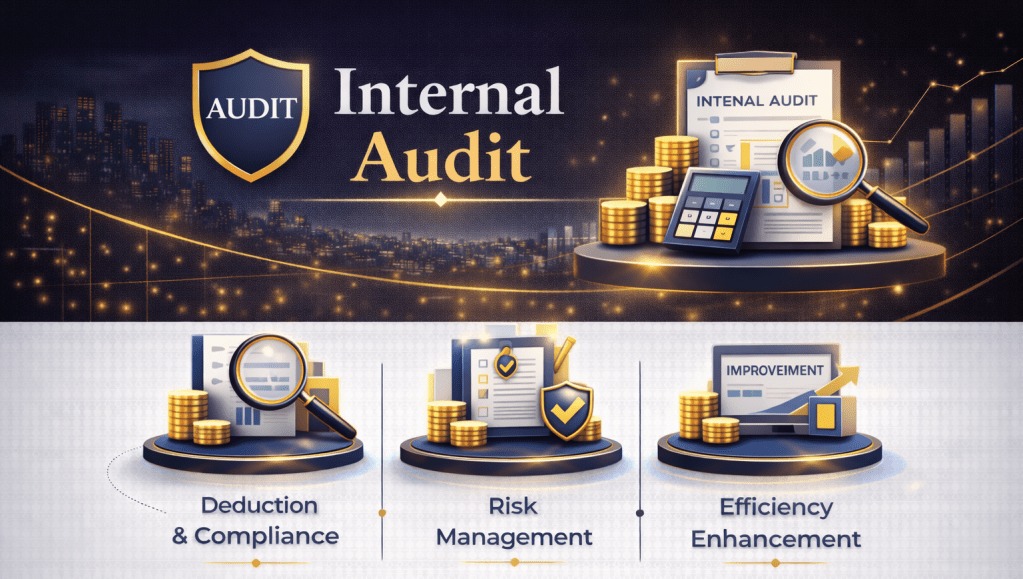
Internal Audit
Independent oversight. Stronger controls. Smarter decisions.
Internal Audit is a systematic and independent evaluation of an organisation’s internal controls, risk management processes, and operational efficiency. Unlike statutory audit, which focuses on financial statement validation, internal audit is management-oriented—designed to strengthen systems, prevent errors, and improve governance frameworks.
At Calculus, Internal Audit is conducted as a risk-based, process-driven engagement aimed at identifying control weaknesses, compliance gaps, and operational inefficiencies before they translate into financial or regulatory exposure.
Objective of Internal Audit
Prevention is more efficient than correction.
- Evaluation of Internal Controls
Assessing whether financial and operational controls are properly designed and effectively implemented to prevent fraud, error, or misstatement. - Risk Identification & Mitigation
Identifying operational, financial, compliance, and strategic risks that may impact business continuity or profitability. - Process Improvement
Reviewing workflows and systems to enhance efficiency, eliminate redundancies, and strengthen accountability. - Compliance Monitoring
Ensuring adherence to statutory requirements, internal policies, and regulatory frameworks applicable to the entity.
Scope of Internal Audit
Beyond accounting — into operations and governance.
- Financial Controls Review
Examination of revenue cycles, expense authorisation, cash handling, and accounting procedures. - Procurement & Inventory Audit
Evaluation of purchase processes, vendor management, stock controls, and wastage monitoring. - Payroll & HR Controls
Verification of payroll processing, statutory deductions, and employee compliance documentation. - Statutory Compliance Review
Assessment of GST, income tax, TDS, ROC, and other regulatory compliances for systemic weaknesses. - Information System & ERP Controls
Review of access controls, system integrity, and data security within accounting or ERP systems.
Internal Audit Methodology
Structured. Risk-based. Analytical.
- Understanding business model and control environment.
- Risk mapping and identification of high-exposure areas.
- Transaction testing and documentation review.
- Gap analysis and control effectiveness evaluation.
- Reporting with actionable recommendations.
- Follow-up review to ensure corrective implementation.
Key Benefits of Internal Audit
- Early detection of fraud or financial irregularities.
- Improved operational efficiency and cost control.
- Strengthened internal governance framework.
- Reduced risk of statutory non-compliance.
- Better decision-making supported by reliable internal reporting.
Internal Audit as a Strategic Tool
Internal Audit should not be viewed as fault-finding—it is a preventive governance mechanism that enhances transparency, accountability, and business resilience. Organisations with strong internal audit systems demonstrate higher financial discipline and lower regulatory exposure.
Internal Audit at Calculus is delivered with analytical rigor, structured risk assessment, and practical recommendations—ensuring that control systems are not only compliant, but efficient, reliable, and aligned with long-term business objectives.

 CALCULUS VISION