
CALCULUS VISION
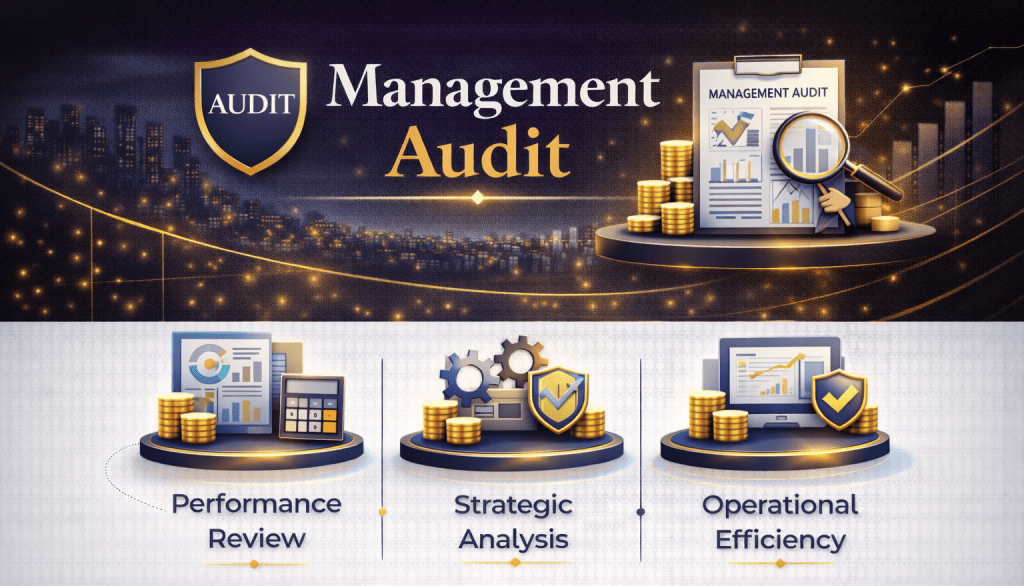
Management Audit
Evaluate strategy. Strengthen leadership. Improve performance.
Management Audit is a comprehensive evaluation of an organisation’s managerial effectiveness, decision-making processes, and strategic alignment. Unlike financial audits that focus on numbers, management audit examines whether leadership practices, organisational structure, and operational strategies are delivering intended objectives efficiently and sustainably.
At Calculus, Management Audit is conducted as a strategic review mechanism—designed to assess performance accountability, governance effectiveness, and organisational efficiency.
Objective of Management Audit
Measure performance beyond financial outcomes.
- Assessment of Strategic Alignment
Evaluating whether organisational goals, policies, and operational activities are aligned with long-term vision and business objectives. - Evaluation of Decision-Making Processes
Reviewing how key decisions are taken, documented, and implemented across departments. - Performance & Accountability Review
Analysing responsibility allocation, reporting hierarchies, and accountability structures within management. - Resource Utilisation Analysis
Examining whether financial, human, and operational resources are being deployed efficiently.
Scope of Management Audit
Holistic review of governance and operational leadership.
- Organisational Structure Evaluation
Assessing clarity of roles, delegation of authority, and internal reporting mechanisms. - Policy & Procedure Review
Examining internal policies for relevance, compliance alignment, and operational effectiveness. - Operational Efficiency Assessment
Identifying process bottlenecks, redundancy, and performance gaps. - Risk Management Framework Review
Analysing how risks are identified, monitored, and mitigated at the management level. - Compliance Oversight Evaluation
Reviewing how leadership ensures adherence to statutory and regulatory requirements.
Management Audit Methodology
Analytical. Structured. Performance-oriented.
- Understanding business model and management structure.
- Conducting interviews and reviewing internal documentation.
- Analysing performance metrics and decision workflows.
- Identifying governance gaps and operational inefficiencies.
- Providing actionable recommendations for improvement.
The focus is constructive evaluation rather than fault identification.
Benefits of Management Audit
- Improved strategic clarity and operational alignment.
- Enhanced accountability and transparency.
- Better utilisation of resources.
- Reduced operational and compliance risk.
- Strengthened governance culture.
Management Audit as a Strategic Tool
Organisations that periodically review management effectiveness are better positioned to adapt to regulatory changes, market dynamics, and growth challenges. Management Audit transforms internal evaluation into a continuous improvement process.
Management Audit at Calculus is delivered with analytical depth and strategic insight—helping leadership refine processes, strengthen governance, and drive sustainable organisational performance.

 CALCULUS VISION