

CALCULUS VISION
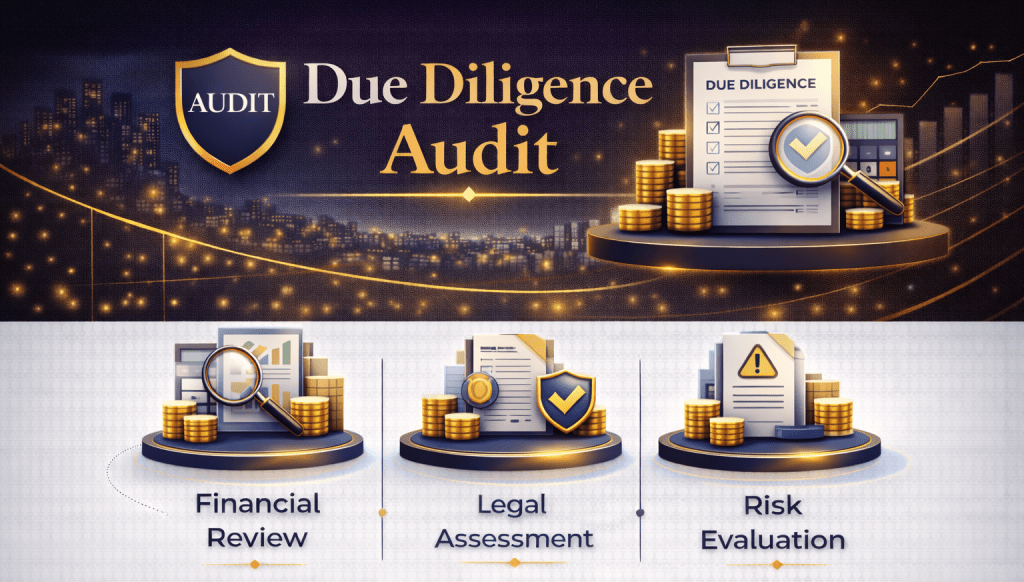
Due Diligence Audit
Verify before you invest. Validate before you commit.
Due Diligence Audit is a comprehensive investigative review conducted prior to mergers, acquisitions, investments, joint ventures, or major financial decisions. It evaluates the financial, legal, tax, and operational position of a target entity to identify risks, liabilities, and value drivers.
A structured due diligence process reduces uncertainty and strengthens negotiation leverage. At Calculus, Due Diligence Audit is executed with analytical rigor, forensic review techniques, and risk-based assessment.
Objective of Due Diligence
Understand the business beyond financial statements.
- Risk Identification
Detecting financial irregularities, contingent liabilities, tax exposures, and compliance gaps that may affect valuation or post-transaction stability. - Validation of Financial Information
Assessing accuracy and reliability of reported financial statements, revenue streams, and profit margins. - Assessment of Legal & Regulatory Compliance
Reviewing statutory registrations, filings, and regulatory adherence to avoid inherited liabilities. - Evaluation of Operational Sustainability
Analysing business model viability, dependency risks, and internal control environment.
Scope of Due Diligence Audit
Multi-dimensional review covering critical risk areas.
- Financial Due Diligence
Examination of revenue quality, expense patterns, working capital position, debt obligations, and cash flow sustainability. - Tax Due Diligence
Review of income tax, GST, TDS, and other statutory compliances to identify past or potential tax exposures. - Legal & Secretarial Review
Verification of incorporation documents, statutory filings, board resolutions, and contractual obligations. - Operational & Commercial Review
Analysis of customer concentration, supplier dependency, pricing model, and scalability potential. - Contingent Liability Assessment
Identification of ongoing litigation, guarantees, disputes, or pending regulatory actions.
Due Diligence Methodology
Data-driven and evidence-based approach.
- Collection and review of financial and statutory records.
- Ratio analysis and trend evaluation over multiple periods.
- Transaction-level sampling and verification.
- Management discussions and clarifications.
- Preparation of risk summary report with quantified exposure areas.
The focus is on identifying material risks and providing actionable insight.
Types of Due Diligence Engagements
- Pre-acquisition or merger evaluation.
- Investment validation for equity or debt funding.
- Joint venture assessment.
- Strategic partnership evaluation.
- Internal due diligence before business restructuring.
Importance of Professional Due Diligence
- Prevents acquisition of hidden liabilities.
- Strengthens negotiation position during valuation.
- Ensures informed investment decisions.
- Protects stakeholder capital and reputation.
- Facilitates smooth post-transaction integration.
Due Diligence Audit is a critical safeguard in high-value transactions. At Calculus, it is conducted with technical depth, investigative precision, and strategic analysis—ensuring that every financial decision is backed by verified facts and structured risk assessment.

 CALCULUS VISION