
CALCULUS VISION
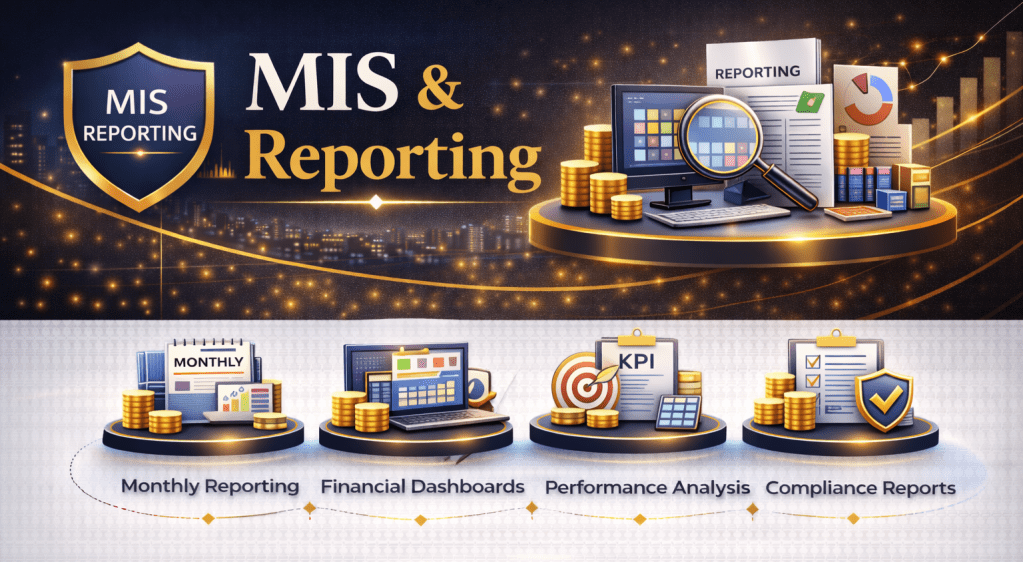
MIS & Reporting
Data converted into decisions. Numbers translated into strategy.
Management Information System (MIS) & Reporting is a structured financial reporting framework designed to provide management with timely, accurate, and decision-oriented insights. Unlike statutory financial statements that focus on compliance, MIS is internally driven—focused on performance analysis, cost control, and strategic planning.
At Calculus, MIS & Reporting is developed as a customised management tool—aligning financial data with operational goals and performance benchmarks.
Objective of MIS & Reporting
Clarity for management. Control for performance.
- Performance Monitoring
Tracking revenue trends, cost behaviour, gross margins, and profitability ratios to assess business health. - Cash Flow Visibility
Monitoring inflows and outflows to ensure liquidity stability and proactive working capital planning. - Budget vs Actual Analysis
Comparing projected financial performance with actual results to identify deviations and corrective action points. - Strategic Decision Support
Providing analytical insights that support expansion, pricing strategy, cost restructuring, and investment decisions.
Scope of MIS Services
Customised to business structure and management needs.
- Monthly / Quarterly Financial Reports
Preparation of summarised financial statements with comparative analysis and key performance indicators (KPIs). - Segment-wise Profitability Analysis
Evaluation of branch-wise, product-wise, or department-wise performance to identify growth drivers and loss centres. - Cost & Expense Analysis
Detailed examination of overhead allocation, variable cost trends, and cost optimisation opportunities. - Receivables & Payables Ageing Reports
Monitoring outstanding dues to improve collection efficiency and vendor management. - Ratio & Trend Analysis
Calculation of financial ratios and historical comparisons to assess operational efficiency and financial stability.
MIS Reporting Framework
Structured. Periodic. Action-oriented.
- Data extraction from accounting systems.
- Validation and reconciliation with books.
- Analytical computation of KPIs.
- Presentation in management-friendly dashboards.
- Strategic commentary highlighting key observations and recommendations.
The emphasis is on actionable insight rather than raw data.
Benefits of Effective MIS
- Improves financial visibility and transparency.
- Enables proactive decision-making.
- Identifies inefficiencies and cost leakages.
- Enhances accountability across departments.
- Supports investor and lender discussions with structured data.
Why MIS Matters
Without structured MIS, management relies on retrospective financial statements that may not capture real-time operational realities. Effective reporting converts financial data into measurable performance indicators.
MIS & Reporting at Calculus is designed to transform accounting data into strategic intelligence—empowering management with clarity, control, and confidence in every financial decision.

 CALCULUS VISION