

CALCULUS VISION
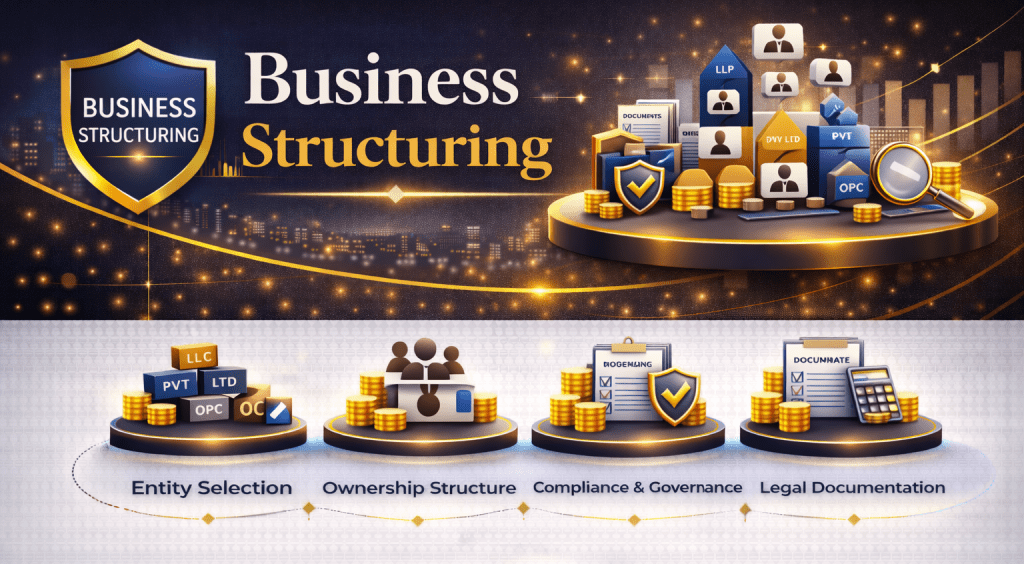
Business Structuring
Design the right foundation. Optimise control, tax, and growth.
Business Structuring is the strategic process of selecting and designing the legal, financial, and operational framework of an enterprise. The chosen structure determines ownership rights, liability exposure, taxation impact, compliance intensity, funding capability, and succession planning flexibility.
At Calculus, Business Structuring is approached as a long-term strategic decision—not merely a registration choice. The objective is to align legal structure, tax efficiency, governance requirements, and scalability with business goals.
Why Business Structuring Matters
Structure influences sustainability.
- Liability Protection
Different structures offer varying degrees of personal liability protection for promoters and stakeholders. - Tax Efficiency
Entity type impacts income taxation, dividend distribution, remuneration structuring, and profit retention strategy. - Compliance Burden
Each structure carries distinct regulatory and reporting obligations under laws such as the Companies Act, 2013, the Limited Liability Partnership Act, 2008, and the Income-tax Act, 1961. - Funding & Expansion Capability
Certain structures are more suitable for investor onboarding, venture funding, or public capital raising.
Key Structuring Options Evaluated
- Proprietorship
Simple structure with minimal compliance but unlimited personal liability. - Partnership Firm
Suitable for closely held businesses with defined partner roles, governed by the Indian Partnership Act, 1932. - Limited Liability Partnership (LLP)
Offers limited liability protection with operational flexibility. - Private Limited Company
Preferred for scalability, investor participation, and structured governance.
Selection depends on risk appetite, capital requirements, and long-term objectives.
Scope of Business Structuring Advisory
Comprehensive evaluation before execution.
- Analysis of promoter objectives and succession planning.
- Capital structuring and ownership distribution planning.
- Remuneration and profit distribution strategy.
- Tax impact analysis across alternative structures.
- Regulatory compliance assessment and cost estimation.
- Multi-entity structuring for group businesses.
- Restructuring advisory for existing entities.
Strategic Considerations
- Whether to retain profits or distribute dividends.
- Interplay between personal taxation and corporate taxation.
- Governance requirements and decision-making control.
- Long-term exit or merger planning.
- Risk diversification across multiple entities.
Benefits of Proper Structuring
- Optimised tax efficiency within legal framework.
- Reduced compliance risk and administrative burden.
- Improved investor confidence and credibility.
- Enhanced asset protection and risk management.
- Structured roadmap for growth and expansion.
When Restructuring May Be Needed
- Rapid business growth requiring corporate conversion.
- Investor entry or equity dilution.
- Operational inefficiencies in current structure.
- Succession or ownership disputes.
- Tax inefficiency under existing setup.
Business Structuring at Calculus combines legal insight, tax strategy, and governance foresight—ensuring your enterprise is built on a foundation that supports stability, compliance, and scalable growth.

 CALCULUS VISION